
기게스
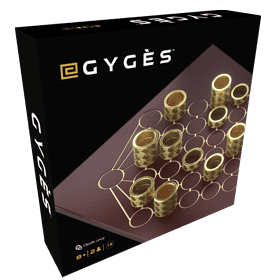 기게스는 기게스 왕의 투명 반지의 전설에서 영감을 받은 추상 전략 게임입니다. 두 플레이어는 서로 연결된 공간의 네트워크를 사이에 두고 마주하며, 각자 보드 끝에 있는 자신의 왕좌를 지킵니다. 플레이어는 자신만의 기물을 소유하는 대신, 세 가지 높이로 구성된 중립 링 세트를 공유하여 제어합니다. 승리는 기물을 잡는 것이 아니라, 끊임없이 변하는 이동 경로를 탐색하여 상대방의 왕좌를 차지하는 것에서 옵니다.
플레이어 수: 1 - 2
게임 시간: 11 mn
복잡성: 3 / 5
기게스 및 다른 게임 1370개를 온라인으로 즐겨보세요.
다운로드가 필요없으며, 웹 브라우저에서 바로 플레이할 수 있습니다.
친구들과 그리고 전세계의 수많은 게이머들과.
무료.


기게스 및 다른 게임 1370개를 온라인으로 즐겨보세요.
다운로드가 필요없으며, 웹 브라우저에서 바로 플레이할 수 있습니다.
친구들과 그리고 전세계의 수많은 게이머들과.
무료.
규칙 요약
Gygès is an abstract board game for 2 players. Players move shared pieces on the board, bouncing off each other, vying to be the first to end a move on the opponent's goal space.
Start of the game
The board has size 6x6. Additionally, two goal spaces are on the board, each located behind the row closest to each player. The goal space is adjacent to all spaces of its closest row. There are 12 pieces in the game: four with one ring, four with two rings, and four with three rings. All pieces are shared; pieces don't belong to either player.
At the beginning of the game, each player receives two pieces of each type and sets their positions on their first row. (With rules for beginners in effect, a player can select one of several predetermined patterns instead.)
Player's turn
In a player's turn, a player must move a piece. Only pieces on the first non-empty row from a player's perspective can be moved. (This means, for example, at the beginning of the game, only the six pieces a player places may be moved; the other six pieces that the opponent placed are not on the first non-empty row.)
A piece must move exactly as many spaces as the number of rings on it. Intermediate spaces must be empty; however, the final space may be non-empty. If it's empty, then the move ends. If it isn't, the player gets to choose one of two possibilities:
- Bounce off the piece: the player gets to move the original piece by the number of rings on the landed-on piece. For example, if a player ends the move on a 1-ring piece, the player can bounce off that piece to continue moving by exactly one space.
- Replace the piece: the player stops the move on that space and moves the landed-on piece to any empty space on the board. The only restriction is that the landed-on piece may not be placed behind the opponent's first row.
If, after bouncing a piece, a player lands on another piece, they must keep choosing whether to bounce or to replace. Only when a player decides to end a move on an empty space or to replace a piece the player's move ends.
A piece may not travel between the same two spaces more than once in a single move. A piece may not pass through the goal space; it may only finish its move there. (The count has to be exact; if it's impossible to finish a move eon the goal space, then the goal space cannot be entered at all.)
End of the game
The game ends when a player moves a piece to land it on the opponent's goal space; this player wins.