
몬스터 트릭
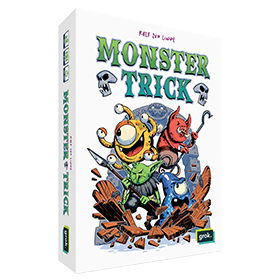 스티클링에서는 한 번에 한 가지 트릭만 하지 않고, 최대 네 가지 트릭까지 할 수 있습니다! 이것은 많은 흥미로운 선택을 소개합니다: 여기서 제공하시겠습니까? 카드들 있나요? 새로운 트릭을 열어야 하나요? 선택지가 너무 많기 때문에 미리 계획하고 가장 많은 점수를 확보할 적절한 시기를 찾아야 합니다.
당신이 이길 트릭의 수를 예측할 수 있나요? 다른 트릭 예측 게임들도 있지만, 동시에 최대 4개의 트릭을 봐야 하는 게임은 없습니다. 예측하는 트릭의 수를 정확히 맞추세요, 너무 많지도 않고 너무 적지도 않게. 만약 당신이 단 1분이라도 집중력을 잃으면, 교활한 상대들이 당신의 기술을 빼앗아 갈 것입니다.
3라운드가 끝난 후 가장 많은 승점을 획득한 플레이어가 승리합니다.
플레이어 수: 2 - 5
게임 시간: 28 mn
복잡성: 2 / 5
몬스터 트릭 및 다른 게임 1414개를 온라인으로 즐겨보세요.
다운로드가 필요없으며, 웹 브라우저에서 바로 플레이할 수 있습니다.
친구들과 그리고 전세계의 수많은 게이머들과.
무료.


몬스터 트릭 및 다른 게임 1414개를 온라인으로 즐겨보세요.
다운로드가 필요없으며, 웹 브라우저에서 바로 플레이할 수 있습니다.
친구들과 그리고 전세계의 수많은 게이머들과.
무료.
규칙 요약
Can you predict the number of tricks you will win? There are other trick prediction games, but none where you must watch up to 4 tricks at the same time. Make exactly the number of tricks you predict, not one too many, nor one too few. If you lose your concentration for even a minute, your wily opponents will take your tricks away... The winner is the player who has the most victory points at the end of three rounds.
Game Components
- 60 playing cards (numbered 1-15, in four colors)
- 20 markers (4 in each color)
- 45 victory points cards (9 in each color)
Game Flow
The game is played over three rounds. Each round proceeds in the following order:
- Shuffle the playing cards (24,36, 48 or 60 cards, depending on the number of players), and deal 12 to each player.
- Each player looks at their cards and decides in which order to place their three victory points cards in front of them.
- For the first round, each player has the three victory points cards with one "pin" on the bottom and the numbers 1, 2, and 3.
- For the second round, each player has the three victory points cards with two "pins" on the bottom and the numbers 2, 4, and 6.
- For the third round, each player has the three victory points cards with three "pins" on the bottom and the numbers 3, 6, and 9.
- Each player places the three victory points cards upside down in a row from left to right in front of them. The order they place the cards depends on how many tricks they think they can win during this round (see below).
- All players play their playing cards following the rules explained in the "Trick Taking" section (see below).
- After 12 turns, the round is over. Each player takes the victory points card they won and places it right side up beside them.
- Continue to the next round.
The game ends after three rounds.
Trick Taking
In the first round, the oldest player starts. In subsequent rounds, the player to the left of the previous starting player starts.
The game is played in clockwise rotation until the round ends, after 12 turns.
On each turn a player plays exactly one card. The player can either play the card on an already opened trick, or open a new trick. (Note: No more than four open tricks are allowed at one time.)
Each trick should form its own pile, and cards played on a trick should be placed so that the value of each card in the trick is visible.
Whoever begins a new trick places their marker beside it to claim it.
Any subsequent player who plays a higher card of the same color on this trick returns the marker to its owner and places their own marker on it.
Rules for placing cards and taking tricks
When placing a card on a trick, players must follow the color of the first card played on that trick. Players can only play a card of a different color on a trick if there is no other place on the table where the different-colored card could be played. However, a player may choose to play a card of a different color on a trick (if allowed) even if that player could play a correctly colored card on that or another trick. (i.e. - Any card may be played from a player's hand on any turn. Once the card is selected for play, it must follow trick placement rules.)
A player may, but is not required, to play on an open trick; as long as there are fewer than four tricks in play, a player may instead choose to open a new trick. A player may open a new trick with a color that is already in play on the table.
A player may play – over several turns – more than one card on the same trick. Note: If a player’s marker is already on a trick, and the same player plays a higher card on it, that player’s marker remains on the trick.
A trick is “full” when the fourth card is placed on it. Whoever has placed the highest card of the opening color discards the four cards and reclaims the marker. The player winning the trick immediately reveals their victory points card on the left in their display area; this card is now “activated”. If the player wins another trick later in the round, that player turns the first victory points card face down, and reveals the next one to the right (and so on).
- Important: When a player wins a fourth trick in a round, the player re-activates the first victory points card; when winning the fifth trick, the player re-activates the second victory points card (and so on).
End of a Round
After 12 turns, all cards have been played and the round ends. Tricks on the table that are not yet complete are ignored.
Each player places their face-up victory points card on top of the other two, and sets the pile aside. The face-up victory points will be counted at the end of the game (i.e. 1, 2, or 3 in the first round; 2, 4, or 6 in the second round; 3, 6, or 9 in the third round). Each player can have a maximum of 18 victory points at the end of the game A player who does not win any tricks in a round (i.e. has no victory points card revealed) leaves all three cards upside down, and scores zero victory points this round.
Prepare for the next round - Shuffle all playing cards, and deal 12 to each player. - Players look at their new cards and place their new set of three victory points cards (2nd round: 2, 4, 6; 3rd round: 3, 6, 9) upside down in any order. - The new round starts with the player to the left of the player who started the previous round.
Game End
The game ends after the third round.
Each player adds the values of the victory points cards won, and the player with the highest total is the winner.
In the case of a tie, the winner is the tied player who won the higher number in the third round, or if still tied, in the second round. If the players are still tied, there is more than one winner.