
파이코
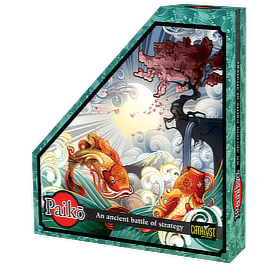 Paiko는 1대1 추상 전략 게임으로, 주요 목표는 자신의 타일을 넓게 배치하고 상대방의 타일을 차단하는 것이며, 상대의 타일을 잡는 것은 즐거운 부차적인 목표입니다.
자신의 차례에는 세 가지 행동 중 하나를 합니다. 게임판에 타일을 배치하거나, 이미 게임판에 있는 타일을 이동하거나, 원하는 타일 세 개를 더 뽑습니다. 게임을 시작할 때 흰색 플레이어는 타일 8개, 검은색 플레이어는 타일 9개를 손에 듭니다. 파이코에는 여덟 종류의 타일이 있으므로, 시작할 때 어떤 타일을 선택할지, 언제 한 차례를 써서 타일을 뽑아 손에 보충할지가 중요한 전략적 판단입니다.
파이코에서는 10점을 얻으면 승리합니다. 게임판에서 상대를 압박하는 위치에 타일을 배치하여 점수를 얻습니다.
플레이어 수: 2
게임 시간: 9 mn
복잡성: 2 / 5
파이코 및 다른 게임 1458개를 온라인으로 즐겨보세요.
다운로드가 필요없으며, 웹 브라우저에서 바로 플레이할 수 있습니다.
친구들과 그리고 전세계의 수많은 게이머들과.
무료.


파이코 및 다른 게임 1458개를 온라인으로 즐겨보세요.
다운로드가 필요없으며, 웹 브라우저에서 바로 플레이할 수 있습니다.
친구들과 그리고 전세계의 수많은 게이머들과.
무료.
규칙 요약
Overview
Paikō is a 2players player abstract strategy game where players take turns deploying tiles on the board and shifting them to advance out of homeground in order to score 10 points and win the game.
Game Board
The game board is made of squares arranged in a diamond pattern. Pieces are deployed in and shifted between the squares. 4 black squares in the middle of the board are inaccessible except to Lotus tiles.
Half squares at the edges of the board serve only decorative purpose and are not part of the game.
The board is split into 4 quarters, of which 2 opposite ones are homegrounds of respective players, and the other 2 are middleground. Having a tile in middleground is worth 1 point, and having a tile in opponent's homeground is worth 2 points.
Each square can be threatened and/or covered by nearby tiles. Threat from a friendly tile allows a player to capture opponent's tiles and also deploy own tiles further away from homeground. Cover protects from a single opponent's threat, but only when checking for capture. While threat is cumulative, cover is not. Homeground squares are always in cover.
Tiles
Each player starts with black or white 24 tiles in their reserve, 3 for each of 8 tile types. Tiles in reserve cannot be used directly and first need to be drawn into player's hand. Once in hand, tiles can be deployed on the board and then shifted. Players draw some tiles (8 for white, 9 for black) into their hands before start of the game.
A tile on the board can be rotated to face any of the 4 orthogonal directions. Each tile has its own pattern of threat and cover that is projected from the tile's position and follows the tile's rotation.
Some of the tiles feature exceptions to the rules that are listed in respective tooltips.
Gameplay
During their turn, each player takes a single one of the following actions:
- 🔴 Draw: take up to 3 arbitrary tiles from reserve and add them to your hand.
- 🔴 Deploy: place a tile from your hand on any square not threatened by your opponent that's either in your homeground or threatened by your tile, then rotate it by any amount.
- 🔴 Shift: move one of your tiles on the board up to 2 squares orthogonally, then rotate it by any amount. It's not possible to move through squares with enough threat for the tile to be captured. Additionally, a single tile cannot be shifted 4 times in a row.
After the action is completed, check for captures. Any action that would result in any of your tile being captured at the end of your turn is not allowed.
Captures
A tile is captured when its square is threatened by at least 2 opponent's tiles (or 3 tiles when in cover). A captured tile is removed from the board which can cause additional tiles to be captured as well. The order of captures is chosen so that as many tiles as possible are captured. Fire tiles are captured all at once, even if they threaten each other.
The owner of each captured tile must choose 1 tile for the opponent to draw from reserve.
End of the game
The game ends in a victory for the player who scores 10 points first. However, if each player has lost 13 or more tiles and has 5 or fewer points the game ends in a tie.